Freedom of Speech and of the Press Are Essential Rights That Are Slowly Eroding in the Modern World…

Featured Story

BY SRH

Donald Trump on Sept. 18 said he has banned three news outlets from the White House.

Trump said on Truth Social that he was, effective immediately, banning CNN, MS Now, and Politico from the White House “as a result of their constant ‘reporting’ FAKE NEWS!”

The president added:

Media Outlets shouldn’t be able to constantly write or report FICTION and LIES when they’re covering the President of the United States, the Trump Administration, or the United States of America. Other Fake News Media Outlets to follow.”

MS Now and Politico did not immediately respond to requests for comment.

CNN could not be reached.

The White House did not immediately respond to a request for more details regarding which stories or posts the president was referring to.

Trump routed them during a post-tweet press conference:

“What I do ask is just a semblance of truth. CNN is fake news. MSNOW is fake news. They’re fake news. They know it. They’re putting there for a reason.”

“Politico was bailed out by our government from going out of business.”

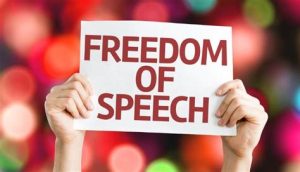
Freedom of speech and of the press are essential rights that are slowly eroding in the modern world.
Under pressure from corporate, government, Islamic, and liberal forces, the right to engage in public debate, to publish unpopular opinions and to report on events are all severely threatened.
This movement is not happening in China or Iran, where extreme censorship is already a way of life, but in the West in places such as Canada, Denmark, the United States and elsewhere.
Here is a quick look at six current threats to freedom of speech and the events that have put each of them into the news.
1. Right to be forgotten
The so-called “right to be forgotten” has become established law in the United Kingdom and now a similar proposed law was just withdrawn in New York.
New York Senate Bill 4561 would have required online search engines and websites to remove (within 30 days) all content of a person that is deemed ‘inaccurate’, ‘irrelevant’, ‘inadequate’ or ‘excessive’.
It would have prohibited them from simply replacing the content with a takedown notice, thus leaving no evidence that the content ever existed. It specifies that the information (even if true) must be removed if it “is no longer material to current public debate or discourse”.
Such a law has already been used in the UK to censor online speech and hide from the public incriminating or historically significant information.
The “right to be forgotten” is an entirely new “right” that does not exist apart from the Internet, and never has, its many detractors point out.
It is unlikely the New York senators championing this bill had thought through what effect it would have had on biographies, online encyclopedias, history texts and news archives?
Erasing parts of the historical record because they are not currently relevant is far too Orwellian for some, but entirely expected from New York government liberals.
This bill may have been withdrawn for now but don’t be surprised if other similar fashioned bills appear in the future.
2. College Campuses Free FROM Free Speech
One publication has recently reported on the use of Bias Response Teams (BRTs) to report on students who express unpopular or anti-liberal opinions.
Reports by anonymous snitches can see students disciplined, expelled or clubs shut down from what would hardly have raised an eyebrow two decades ago.
The rapid growth of the “safe-spaces” philosophy is another consequence of the anti-free speech mentality on college campuses.
Rather than serving as forums for open intellectual discourse, universities are increasingly trying to shelter students from opposing viewpoints.
The Foundation for Individual Rights in Education (FIRE) found that an astonishing 42% of these BRTs contain law enforcement officers, now literal speech police.
Hate speech is not at issue here, nor speech that incites violence. Conservatives are most often the targets, but so too are professors who simply ask students to think and debate with an open mind, as in the case of a University of Northern Colorado professor who was targeted for asking students to think and debate openly on controversial subjects.
The professor received an official reprimand for trying to approach controversial subjects, and he is far from alone as student clubs are shut down, speakers dis-invited and classes closed for fear of offending “delicate snowflakes” with alternative viewpoints.
3. Google Flagging Upsetting-Offensive Content
Google has for years flagged and demoted search results content that is pornographic, low quality or dangerous and, when done right, this can serve as a huge benefit to the Internet community.
The problem lies in where the line is drawn as the search giant has recently begun flagging another category of content that it labels as “Upsetting-Offensive”.
Some Christian ministries devoted to helping Homosexuals leave the gay lifestyle have seen their videos and content blocked for this type of classification.
The offensive content flag covers a wide range of anything considered “hate” and could presumably be expanded to Christian websites that suggest other world religions are false in any way or that Jesus Christ is the only way to salvation.
What is “hate” is open to interpretation and no doubt will be the ongoing debate among monitors of “offensive” content.
4. Pakistan Requires Twitter and Facebook to Remove Blasphemous Content
Pakistan began a decade ago blocking social media sites one at a time as users posted content offensive to Islam. Youtube, Facebook, Twitter and WordPress.com have all been blocked.
Yet this is not enough for the government of Pakistan. The government of Pakistan is now demanding the identities of people who blaspheme on Twitter and Facebook (either foreign or using VPNs to circumvent the blocks within the country) so that they can face arrest.
Previously, Youtube bowed to Pakistan’s demands and removed offending content in exchange for a temporary lift to the ban.
The sentences for blasphemy in Pakistan range from fines to death.
The Pakistan Telecommunications Authority (PTA) continues to pressure international companies and foreign governments to enforce their laws on blasphemy and with legal developments from Europe and Canada, the chances of compliance are looking better.
5. New Canadian Blasphemy Law
In Canada, lawmakers have been busy proposing a series of new laws over the past year that would criminalize criticism of Islam under the label of Islamophobia.
Resolution M-103 in 2016 by Liberal MP Iqra Khalid and now a nearly identical motion (M-37) that was passed by the Ontario provincial parliament in February of 2017 will charge the government with stamping out criticism of Islam and punishing criticism of the religion.
Islamophobia is never formally defined, so this relatively new term can be stretched to mean anything from criticism of the religion to condemnation of female genital mutilation.
6. Danish Man Charged with Blasphemy for Burning Quran (first since 1946)
For those who still believe that Northern Europe is a paradise of free speech and the censorship of migrant crimes in Germany, Denmark and Sweden weren’t enough to shock you awake, a Danish man is now charged with blasphemy for burning a Quran in protest.
A 42-year-old man who posted a video on Facebook of burning a Quran is now the first person to be charged with blasphemy in Denmark since 1946. His identity is being withheld until he is convicted, as is the law in Denmark.
Curiously, it is not a crime to burn the Danish flag in Denmark but the tensions over free speech that have been ramping up since 2005 when Danish newspaper Jyllands-Posten published 12 cartoons depicting the prophet Muhammad.
The video, titled “Yes to Freedom – No to Islam”, didn’t garner more than a few hundred views in Denmark at the time, but the man’s lawyer is now framing the Qur’an burning as self-defense because the Qur’an calls for the killing of non-Muslims.
Where Is This Leading?
Pull the top six news stories on freedom of speech now and you are likely to see a similar pattern.
Islamic theocracies condemning individuals for blasphemy and Western democracies following right along after them, universities banning freedom of expression for fear of exposing students to new ideas, actively censoring information in the historical record that is uncomfortable for those who want to forget and using social media to enforce a single view of the world.

Don't Miss

Banks Do Not Always Command The Public’s Trust

By StevieRay Hansen

Banks are running out of time to regain public trust Isaiah lived in a time when Judah was struggling under the weight of injustice: “Justice…

Google Should Be Afraid. Very Afraid

By StevieRay Hansen

Critics of Christianity have become more vocal recently. This is partly because there are many people who do not believe in God or understand the…

Predatory Banks And Their Rip-Off Overdrafts

By StevieRay Hansen

Greed refuses to be satisfied. More often than not, the more we get, the more we want. Material possessions will not protect us—in this life…

After Reaching Milestone, Is Bancorpsouth Bank (NYSE:BXS)’s Short Interest Revealing Something?

By StevieRay Hansen

Money changers were associated with others who engaged in shady business practices in the temple courts. Some sold sacrificial animals, overcharging people who did not bring…

First bank failure since 2017 is a wake-up call

By StevieRay Hansen

Why is the love of money a root of all kinds of evil? To help us answer this, we must look at the passage in…

Posted in

Stevie Ray

Leave a Reply

Your email address will not be published. Required fields are marked *