BY SRH
Slowly the data center dream is turning into a nightmare.
Over the weekend, we reported that the price on the massive $18 billion leveraged loan backing Oracle’s just as massive $165 billion, 4.5GW New Mexico data center, Project Jupiter, had fallen to “stressed” levels around 89-91 cents on the dollar.
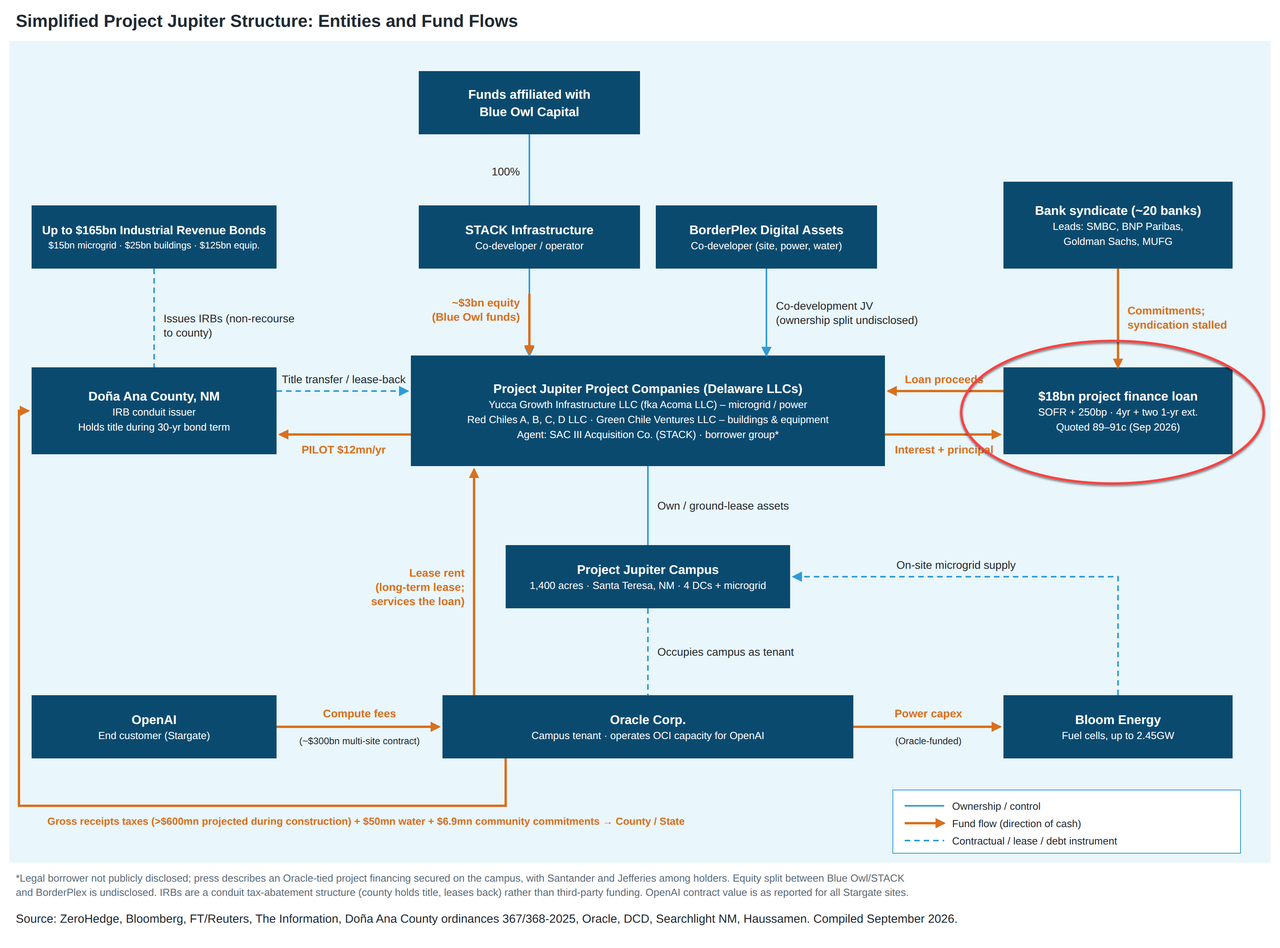
What makes the price slide from par in just a few months especially concerning is that the 1,400-acre data center campus in Doña Ana County is at the heart of Oracle’s landmark $300bn contract with OpenAI to provide computing power. The marquee project secured $18Bn of loans from a consortium of banks late last year to kick-start construction, along with billions of equity investment from Blue Owl.
As for why the price is dropping, the answer is simple: the market is getting increasingly concerned that the data center will not be built on time (if ever) amid extreme grassroots opposition to data centers. Most recently, the project has faced due to fierce local opposition over concerns about its impact on the local area’s water supply and air quality. The project was initially going to be powered by 2.2 gigawatts of gas turbines, but the state land office blocked a request to run a natural gas pipeline to the data center.
Worse, Deb Haaland, New Mexico’s Democratic gubernatorial nominee and a former US Interior secretary, said she would pause all new data centres if elected in November and require developers to heavily invest in renewable energy. In other words, a Blue sweep virtually assures years of delays.
But it’s not just the Project Jupiter data center.
Readers may recall that a month ago, Nvidia announced it would back a massive, 4.25GW SoftBank data center (which won’t be completed for years) with $105 billion in additional funding. The project, led by SB Energy – subsidiary of the Japanese conglomerate SoftBank that aspires to build the largest data center project in the world (because it wouldn’t be like Masa Son to go for anything but the world’s biggest) in Ohio – is set to be fully leased to OpenAI, and could eventually grow to 10GW, making it the world’s largest data center (but let’s get to just 1GW first though).
Nvidia – which initially planned to support the SB Energy project with as much as $250bn, but got cold feet after facing investor pushback over the extent of the risk – will provide a $105bn “residual value guarantee” backstop for the project, helping lower debt costs.
Nvidia will also invest $1.5bn in SB Energy, down from a reported $3bn. The SoftBank subsidiary, which we said in August was preparing for an IPO, is planning to build 10GW of new power generation, including 9.2GW of natural gas generation, to power the facility. This will provide up to 8GW of total IT load, making it the world’s biggest data center when finished.
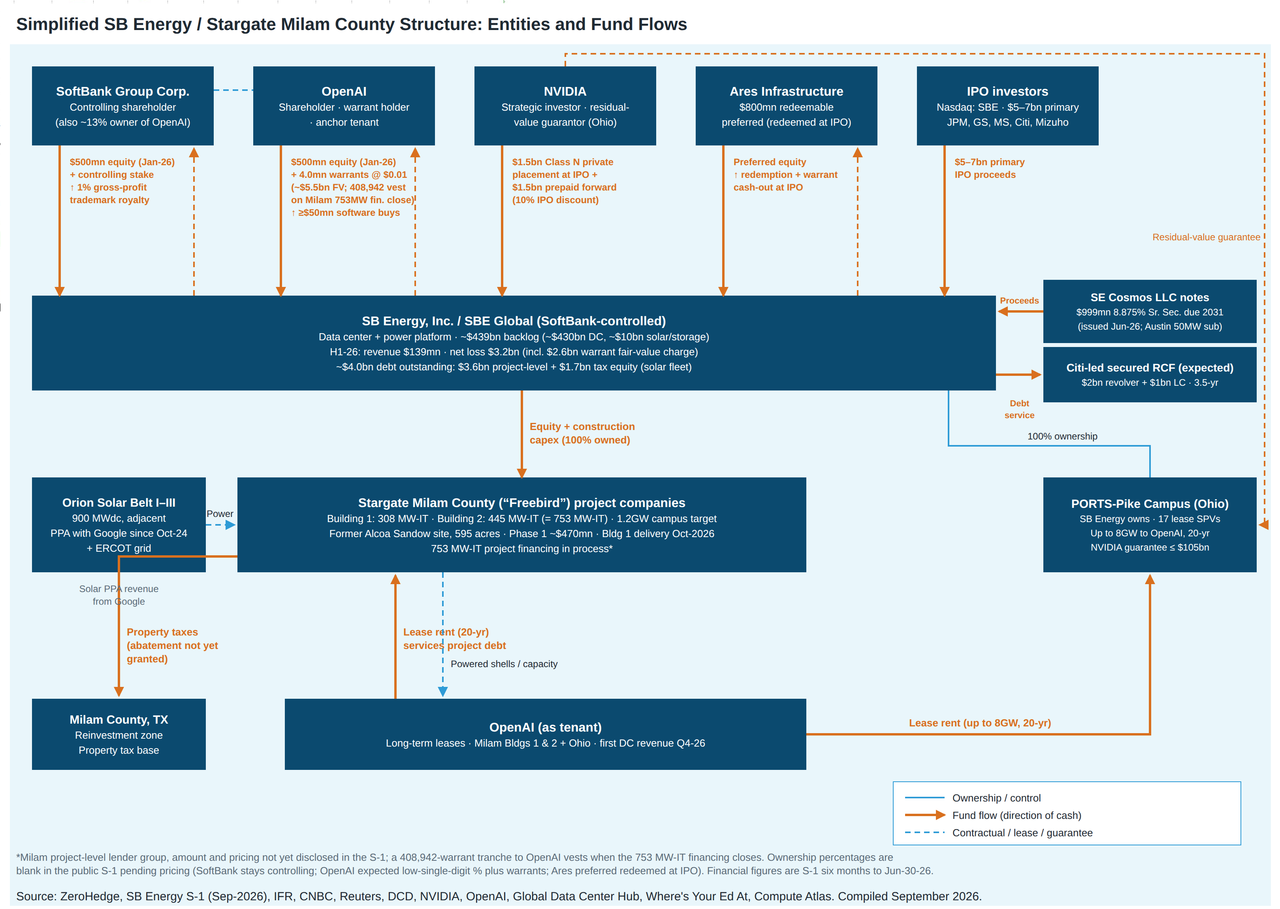
Yet fast forward just one month to today, when said IPO – whose proceeds are so very critical to the continued construction and timely completion of the project – has been pulled.
According to the NYT, while SB Energy had originally planned its I.P.O. for this month, the offering has been delayed, as investors question the company’s sought-after valuation of $50 billion or more. The report goes on to note that so far, bankers have struggled to find enough buyers of SB Energy stock within price ranges the company and its bankers had sought.
SB Energy’s struggles to win over investors come at the worst possible time: just as the backlash against data centers that is shaping elections and kitchen table debates across the country (which we warned about last summer) is now spilling onto Wall Street with “investors voicing increasing skepticism about the growth expectations for data centers and the risks associated with their build-out, forcing industry executives and their advisers to recalibrate their plans to raise tens of billions of dollars in public markets.”
The pulled IPO also comes just days after Holtec – which specializes in nuclear energy technology, spent fuel storage, small modular reactors (SMRs), and nuclear plant decommissioning and is hoping to supply power for AI – said last week that it was pausing its I.P.O. plans indefinitely, citing several factors that have “impaired investor confidence in the market for new public offerings.”
Holtec pointed to the “uncertainty of data center development” as the primary reason for the postponement, according to a company release. Holtec Nuclear owns and operates one main nuclear power site and builds small nuclear reactors that can be used to power data centers. The company, which had planned to start trading on Nasdaq last week, was seeking to raise as much as $900 million at a valuation of up to $10 billion.
The delays, the NYT notes, “are a rare hiccup for the A.I. industry, which has enjoyed almost unbridled investor enthusiasm in recent years.”
The rest of the article is boilerplate, repeating the same stuff we have warned about since mid-2025:
Public opposition to data centers has built for months as communities push back against these sprawling, power-guzzling facilities that have sprung up across the country, particularly in rural areas.
Heading into the midterm elections, data centers present an unusual issue that many voters from both parties oppose. They have become a focal point for the public’s angst about an economy dominated by artificial intelligence.
Over the past week, fears over artificial intelligence hit a fever pitch as A.I. executives warned of the technology’s dangers and suggested slowing down the pace of development.
In this context, a growing number of states have taken their own steps to curtail data center development, creating roadblocks for companies looking to raise money from public investors. Earlier today, we reported that “Texas Governor Abbott Orders Halt To New Data Centers Weeks After Issuing Moratorium.”
Not surprisingly, this hostile environment is snuffing out most enthusiasm for data center prospects. To wit: there are only two publicly traded companies that focus solely on building data centers: Equinix and Digital Realty Trust, and their share prices have fallen between 1 and 2% this month. This is very troubling when one considers that data-center companies had been expected to account for roughly one-third of all listings for the remainder of 2026, per NYT sources.
It also doesn’t help that among the data center companies seeking to go public, there’s a wide dispersion of operating track record and history and customer concentration. Most projects are in the early stages, leaving the companies vulnerable to execution risks.
Investors say that is one of the risks giving them pause about SB Energy.
SB Energy has agreed to build, own and operate a data center in Ohio, which is fast becoming an epicenter of the political debate against and public outcry data centers.
And while SB Energy has huge ambitions (as noted above, the biggest data center it plans on rolling out will be the world’s biggest when completed) it has yet to put one into operation. Worst still, despite its non-existent track record, the company projects a revenue backlog of $439 billion that it will receive over roughly 20 years beginning in 2028, mostly from the Ohio data center
Last week, with the IPO still in the works, SB Energy tried to win over investors by hosting a call with OpenAI’s chief financial officer, Sarah Friar, and its head of infrastructure, Sachin Katti, who discussed the merits of the Ohio data center. Some investors said SB Energy’s decision to present senior executives from OpenAI – the company’s core tenant – showed its awareness of the skepticism.
In the end, it wasn’t enough since the IPO has now been delayed. While SB Energy released its financials on Sept. 1, it is not expected to go public before mid- to late October, later than its original schedule.
According to the NYT, two people familiar with the company’s plans said they both wanted the option to go public in September and to also give investors more time if needed to get comfortable with its future plans and its financials.
Why? Well, the recent collapse in token prices and the surge in Chinese open-weight models which has grabbed market share from US frontier models, such as OpenAI, may have something to do with it.
Looks like today may be a record day for token volume % of open models on Vercel AI Gateway:
🟦 Open 78.4% 🟨 Closed 21.6%
While spend 💲 usually tells a different story, #3 and #4 today are Moonshot AI & DeepSeek. Adding Z.ai, their combined spend surpasses OpenAI (#2).… pic.twitter.com/vFMh3xEt83
— Guillermo Rauch (@rauchg) September 19, 2026
To be sure, some companies have had more luck than SB Energy: Nscale, which has plans to develop data centers across the globe and counts Anthropic and Microsoft among its customers (because there really are just 4 or 5 customers in the world that can make a dent right now, and these two are among them), disclosed its finances Friday in preparation for a public offering in October. Bankers and investors say it could be the first test of how the market will price these deals in this more discerning environment.
“You cannot be long on artificial intelligence and not be supporting infrastructure build-out because this has to go hand in hand,” said Harmol Samra, chief executive officer of Host Digital, a data-center developer.
Well… you can. You just don’t have to lock yourself in to the first valuation that comes along.
Take Hyperion, aka Project Beignet, Meta’s original project financing template (which has been adopted by virtually all subsequent data center developments) and its its massive 5GW New Orleans Data Center, which – like all other projects – will be completed some time in the 2030s.
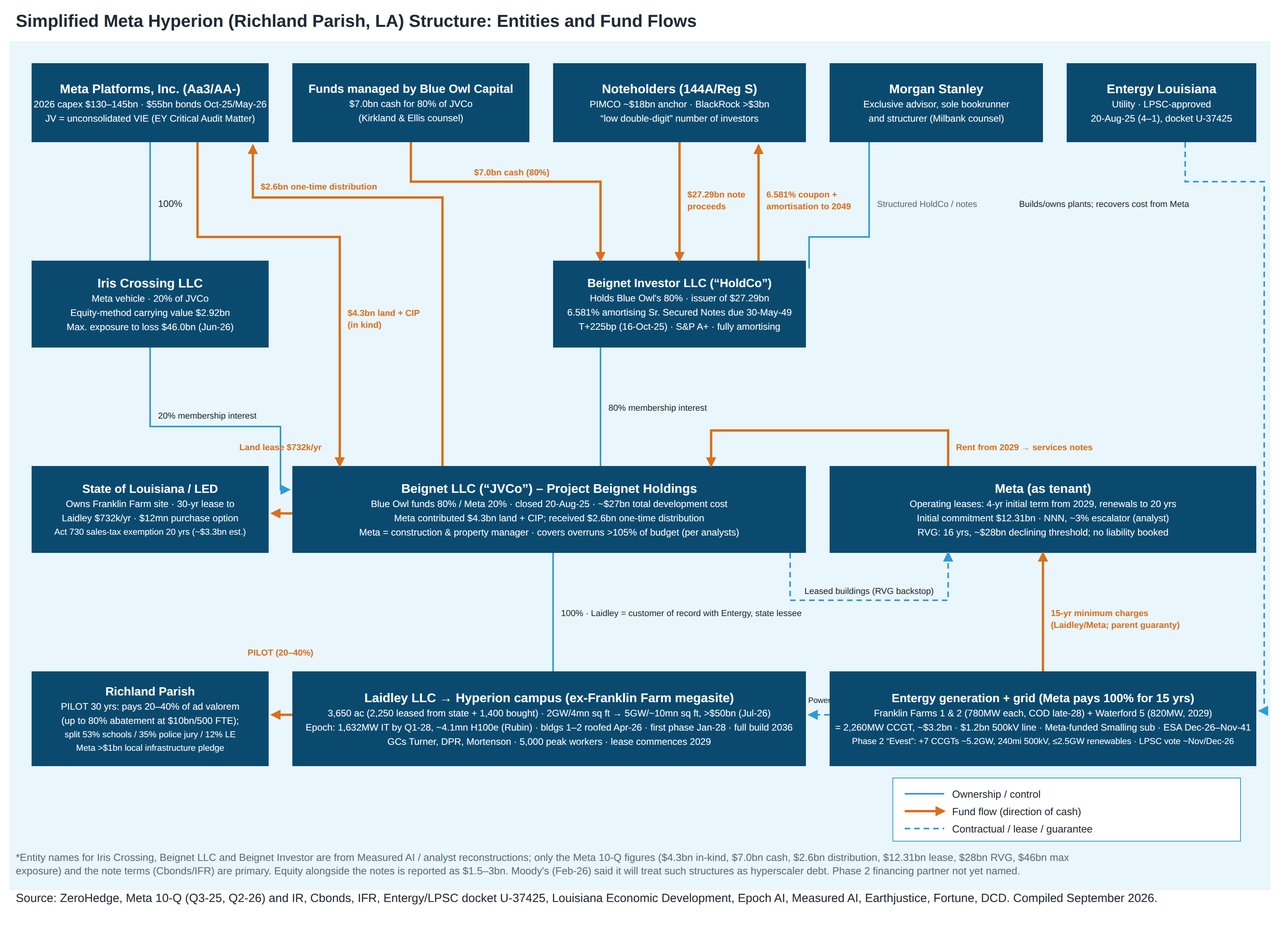
When it first came to market with the gargantuan (total investment now is $50BN and rising fast) data center, Meta issued $27 billion in bonds to fund the project. This was (and still is) the single biggest investment grade offering in the world.
Well, after it traded up to 110 cents on the dollar shortly after the break, the bonds due 2049, which were priced to yield 6.581%, have since sunk pretty much in a straight line, and are now trading near all time lows less than a year after their issuance, last seen just over 94 cents on the dollar…
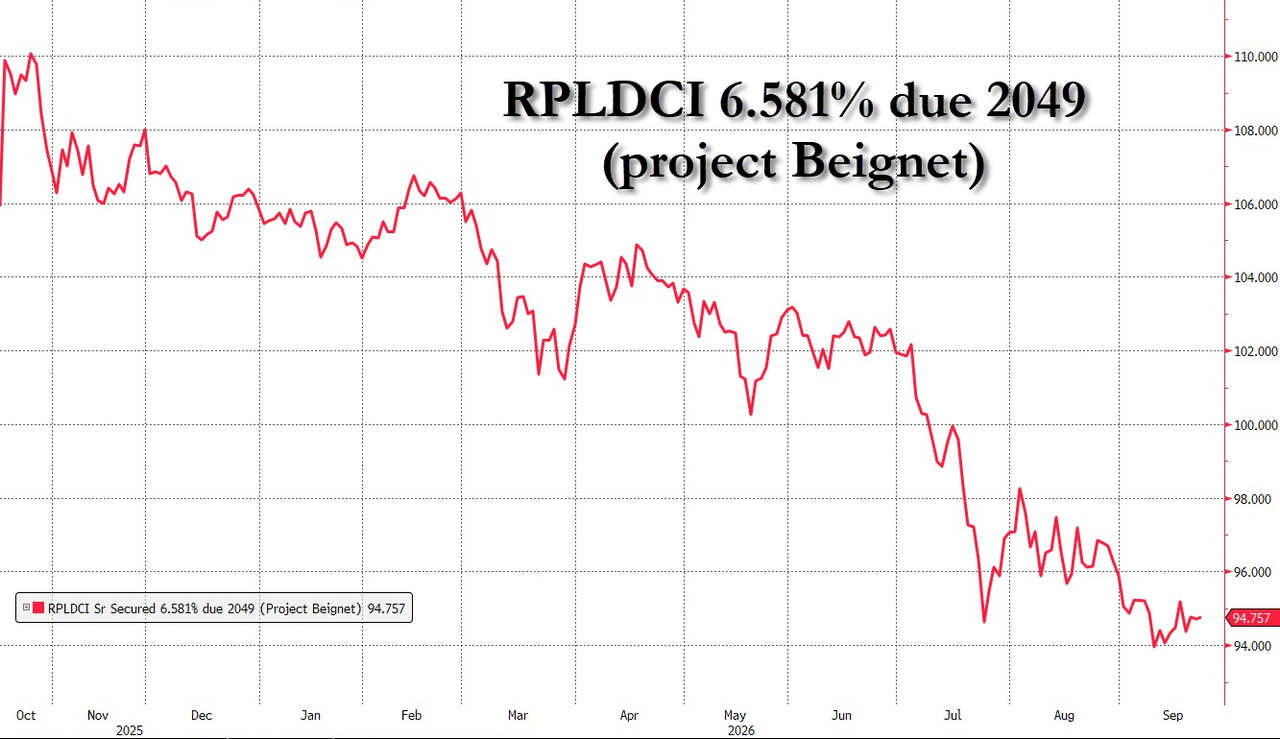
… and blowing out in spread from 140bps originally to 210bps now, much to the Chagrin of the project’s biggest bond investor, Pimco, which holds about $15 billion of the debt.
For those asking what can possibly break the stock market party, where various AI-linked stocks have pushed the market to record highs even as most stocks keep dropping (today we just had the 6th day in a row of more 52 week lows than highs), look no further than the chart above, and also follow what happens to the SB Energy IPO. Since it can’t be pulled, SoftBank will end up having to downsize it (and the project’s valuation) significantly, meaning it will have to find even more sources of capital who will demand even more preferential terms, and so on, until the big picture turns either much more attractive (don’t expect that to happen if Democrats sweep in November) … or much worse (which will happen if China continues capturing LLM market share and pummeling token prices) at which point SoftBank will have to pull the plug.
Which, incidentally, would would have devastating consequences for Sam Altman’s OpenAI IPO, as two of the five most important data centers of the company’s Stargate initiative – Project Jupiter and SB Energy, which collectively would account for over 10GW in compute – go dark. Source: ZeroHedge