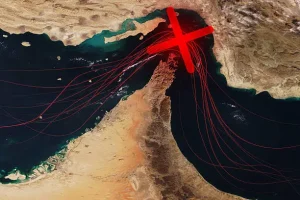
On Wednesday, the gang attacked two Saudi oil tankers in the Red Sea and threatened to increase their attacks until they cut off “all access routes” to Saudi oil exports. Deputy military spokesman Brig. The Saudi tanker Wafa was attacked in the port city of Yanbu in the country, according to General Yahya Saree.
In a subsequent social media post, the spokesman added that a second oil ship named Daisy was “forced to turn back” after being hit by a ballistic missile in the Gulf of Aden. This tactic is being called a “blockade for blockade” by the Houthis.
The fragile Oman-sponsored talks to reopen the Strait of Hormuz are being threatened by the escalating conflict in the Red Sea region. However, it appears that the Saudis are not ready to back down. On Thursday, the Yemeni Armed Forces, acting as a proxy for the official government in Aden, the southern region, announced plans for a large-scale military operation.
This comes as Al Arabiya claims that ground violence has broken out again, ratcheting up the civil war that began in 2015 (and also includes international proxy war elements). According to the Arab news outlet, 45 government forces were killed in an attack by the Houthis in Hadramawt and Marib, two regions of Yemen that contain most of the country’s gas and oil reserves.
In two separate reports, Al Jazeera details the same incident:
According to the internationally recognized government of Yemen’s Yemeni Emergency Forces, their camps have been attacked, resulting in both material and human casualties.
A alleged missile and drone attack by the Houthis on bases hosting the soldiers in Hadramaut and Marib resulted in multiple casualties.
It appears that a separate ceasefire will be necessary to contain the crises in Yemen and the Bab al-Mandab Strait, even if a grand Hormuz deal to reopen energy transport can be achieved with some degree of staying power.
As a kind of good cop, bad cop behavior against the US and its Gulf allies, the Houthi blockage of Saudi shipping in the Red Sea is symbolic to a certain extent. This allows Tehran to keep some indirect influence over the world’s oil supply, even while ships in Hormuz might resume their normal operations.
Iranian ‘Axis of Resistance’ Houthis Central
Just in case you forgot, the Houthis have been a member of the Shia rebel group’s “axis of resistance” since the group’s 2014 September takeover:
The expanding U.S.-Iran war is putting pressure on Saudi Arabia from three directions: Iran to the east, Yemen to the southwest, and Iraq to the northeast. (The first direct hit on Saudi land by Tehran in nearly four months occurred on July 18 when it bombed Prince Sultan Air Base near Riyadh.)
Seeing the problems as a nest of nesting dolls might help you grasp their significance beyond the oil price.
The internal doll represents Yemen’s internal civil war, which has been going on for ten years and is fought between the Houthis, formally known as Ansar Allah, who control the northern population from Sana’a, and the internationally recognized government of Yemen, officially headed by the Presidential Leadership Council. This conflict began in 2011 with the Arab Spring upheaval, which deposed Yemen’s long-serving president and created an opening for the Houthis, who captured Sana’a in 2014 in an effort to fill the power vacuum. Since Saudi Arabia and its allies launched an intervention in 2015 to restore the internationally recognized government and reverse the takeover, the war has persisted in various forms.
The middle doll represents the larger rivalry between Saudi Arabia and Iran, which has persisted since the Islamic Revolution of 1979, when the new theocratic government in Tehran started exporting a revolutionary, Shia-inflected challenge to the Sunni monarchs of the Gulf. This fight has been going on for regional leadership.
Meanwhile, on Thursday, Al Jazeera reported that the government, which is backed by Saudi Arabia, shot down a drone operated by the Houthis over Marib.
The official SABA news agency of the country stated that the Houthis’ decision to target Marib “embodies their escalatory approach and their insistence on continuing their terrorist acts” and added that “the air defenses engaged the drone as soon as it entered the city’s airspace and successfully shot it down.”
In the Persian Gulf region, Iranian officials have announced that they are “on the verge of being finalized” with Oman to reopen the Strait of Hormuz after establishing entry and exit routes and regulations. Iran maintains its stance that the US is uninvolved and cautions against any military intervention by the US.
After days of deafening bombing, the White House appears intent on securing a withdrawal from the battle this time around.
Instead of killing people, Trump would prefer to make deals.
A final deal might be completed by the end of the week, or even by Thursday, according to certain international media. However, there are still a lot of unknowns and factors. According to Al Jazeera: “For Iran to reopen the Strait of Hormuz, the US must abide by the memorandum of understanding (MoU) it signed with Iran in mid-June, although that would not be enough on its own, Iranian Deputy Foreign Minister Kazem Gharibabadi said in comments carried by Iran’s IRNA news agency.”
The Iranian foreign minister, Abbas Araghchi, recently issued a warning, saying, “We’re ready to retaliate, but finding a diplomatic solution is the best way to avoid wider escalation and destruction across the ⁷region.”
I would like to reach an agreement rather than resort to violence,” Trump recently said. It is impossible for Iran to possess nuclear weapons. Don’t Count On anything Trump Says!!