BY SRH
Everyone Should Be Afraid of Everything, From the Plague to the Price of Oil to a Storm Coming To the Gulf of Mexico.
Oil prices rose by approximately 4% on October 8 as attacks on shipping in the Persian Gulf and the Strait of Hormuz heightened supply concerns, while a tropical cyclone threatened US offshore output.
By 12:17 p.m., U.S. West Texas Intermediate crude was up $3.47, or 3.9 percent, to $92.40. Brent crude futures rose by $4.20, or 4.15%, to $105.41 a barrel.
Oil prices fell on October 7 after the International Energy Agency said that its members had agreed to accelerate the release of emergency oil inventories and prioritize diesel.
However, the ongoing danger to shipping in the Strait of Hormuz has markets on edge.
Since the beginning of October, at least nine tankers have reported being struck by unexplained missiles, according to the UK Maritime Trade Operations.
The events involved crude oil, liquefied petroleum gas, and other ships, with several of them on their way out. In some cases, the projectiles started fires or damaged engine rooms, including one on Oct. 5 that the crew was still fighting when the alarm was sent.
So yet, no injuries or environmental damage have been reported, and at least two crews have confirmed their safety.
Separately, the UKMTO reported that on Oct. 5, a tanker approaching the strait was hailed by Iran’s Islamic Revolutionary Guard Corps (IRGC) around 11 nautical miles north of Khasab, Oman, and instructed to turn back or be targeted; the master obliged.
The UKMTO did not name the party responsible for the strikes, merely stating that investigations are ongoing and advising vessels to proceed with caution.
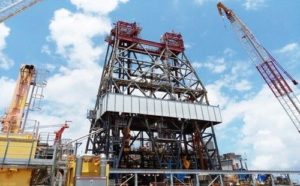
The weather is also putting pressure on the markets. Shell and Chevron announced on October 7 that they were suspending offshore activities in the Gulf of Mexico as Tropical Storm Isaias approached the north shore, affecting output in the United States.
The National Oceanic and Atmospheric Administration’s satellite image of Tropical Storm Isaias near the eastern coast of Mexico on October 7, 2026.
According to the National Hurricane Center, the storm began in the Gulf on Oct. 7 and is expected to grow into a hurricane before reaching the southern US coast early Oct. 10, bringing torrential rain, storm surges, and probable tornadoes to multiple states.
On October 7, Phil Flynn, an analyst with Price Futures Group, cautioned that the storm could trigger shutdowns and refinery troubles at a time when diesel is already in short supply owing to the Iran war, calling a Gulf Coast impact “the last thing this market needs.”
Pressure on Shipping
On Oct. 4, the US Navy-led Joint Maritime Information Center stated that the IRGC’s interruptions in the Strait of Hormuz show Iran’s desire to keep pressure on transiting vessels and assert its presence along crucial transit lanes.
On October 8, Iran’s military leadership said that it had reestablished control of the Strait of Hormuz.
Brig., the commander of the Iranian army. General Mohammad Hossein Dadras stated that Iran’s armed forces were “more prepared than at any other time.” The words, broadcast by Iran’s state-run Islamic Republic News Agency, did not mention the recent attacks on shipping in the strait.
They also followed top IRGC adviser Brig. Gen. Mohammad Reza Naqdi’s October 7 statement to the Al-Alam News Network that Tehran has “full control” of the waterway.
On September 5, 2026, vessels traverse the Strait of Hormuz off the coast of Bandar Abbas, a port city in southern Iran.
He also stated that the amount of “smuggled” oil going through the strait was limited, and that the small-boat channels used to transport it to larger tankers would soon be closed.
On October 7, the United States Central Command denied the claim, stating that the canal was in the responsibility of Washington and its regional partners.
“Traffic is flowing through the Strait of Hormuz right now carrying commercial goods and energy supplies, including 20 million barrels of crude oil,” Central Command said.
The US Energy Information Administration said on Oct. 7 that Middle Eastern oil flows will likely remain constricted until the end of 2026, although convoys across the Strait of Hormuz and workarounds such as bypass routes and ship-to-ship transfers should boost regional output and exports.
The press that has been there for a long time, always looking for superficial reasons and never getting close to the reality. Threat of a storm? The news is that the stock market frequently and consistently has a mind of its own, completely independent of the absurd ideas that are propagated by a press that is ignorant. That is a well-known truth.