
By Pam Martens and Russ Martens: January 9, 2024 ~
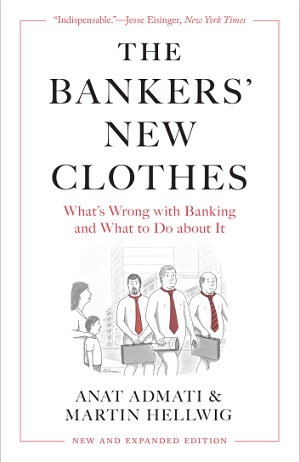
Last September, speaking at a conference sponsored by the nonprofit watchdog, Better Markets, to examine if “too big to fail” banks had materially changed in the fifteen years since the 2008 financial collapse, Anat Admati, Professor of Finance and Economics at Stanford Graduate School of Business, offered her assessment of the U.S. banking system: “Corruption has become the system.”
Today, Admati’s celebrated 2013 book, The Bankers’ New Clothes: What’s Wrong with Banking and What to Do about It, co-authored with German economist Martin Hellwig, is being released in an expanded new edition. It is a must read for every American who is bold enough to remove their media tinted, rose-colored glasses and take a hard look at how the U.S. banking system got into the mess it’s in today.
Although written by serious academics, the book provides a courageous, fascinating, and easily digestible read for the layperson.
The new edition brings the reader up-to-date with the bank runs and second, third and fourth largest bank failures in U.S. history that occurred in the spring of last year, along with four new chapters: “Too Fragile Still,” “Bailouts and Central Banks,” “Bailouts Forever,” and “Above the Law?”
The two chapters focusing on the endless bailouts of the U.S. central bank, the Federal Reserve, and its foreign counterparts, are particularly timely. We are reminded by the authors that when President Obama signed the financial reform legislation known as the Dodd-Frank Act in 2010, he declared: “No more bailouts. Period.” What the American people have discovered, however, is that only the word “bailout” changed in mainstream media’s coverage of the Fed’s efforts to save the mega banks from their reckless practices. In place of the word “bailout” has come an alphabet soup of acronyms for emergency lending operations by the Fed, defying the human brain’s ability to keep up with the serial subterfuges. As a result, write the authors, “the ever-broader safety net for the financial system suggests that the system may be becoming ‘too big to save.’ ”
The moral hazard of what the U.S. central bank and its peers have been doing since the financial crisis of 2008 has “enabled and even exacerbated the fragility of the banking system in recent years,” according to the authors.
This is the second time that serious researchers have used the word “fragility” of late to describe the U.S. banking system – a system that Wall Street bank titans continuously describe as the “envy of the world” in their testimony before congressional hearings. As we explained on January 2, the federal agency created under Dodd-Frank to prevent a replay of the financial crisis of 2008, the Office of Financial Research (OFR), warned in a research brief released just last month that the U.S. banking system remains “fragile and uncertain.”
That analysis stands in stark contrast to what the head of the U.S. central bank, Jerome Powell, told Congress six months earlier – that “The U.S. banking system is sound and resilient.”
For readers still mystified as to why central banks even exist and how the U.S. central bank came into being, the new edition of the book provides an excellent timeline and engaging stroll through history.
The final chapter of the book provides a very legitimate (and frightening) analysis of how recklessness at the mega banks has evolved into serial lawlessness, probing what this means for American democracy and the rule of law.
Treat your skin well. Our soaps are gentle and produce a smooth, creamy lather that is nourishing to your skin. They are handmade in small batches. We use only high-quality natural ingredients. No chemicals, no sodium laurel sulfate, no phthalates, no parabens, no detergents. GraniteRidgeSoapworks






Like