BY SRH
According to the Florida Department of Law Enforcement (FDLE), 31-year-old Jerry Sneed from Orlando was arrested on Wednesday after allegedly making threats against a Jewish residential community in Glades County. Authorities report that Sneed used social media to issue written or electronic threats to kill, injure, commit a mass shooting, or conduct an act of terrorism. He also allegedly shared the location of the community and photos of a firearm.
The FDLE’s Fort Myers office began investigating Sneed on October 19 following reports of threatening social media posts that included images of a gun and reference to the community. Sneed was apprehended by FDLE agents and the Orange County Sheriff’s Office; the firearm depicted in the posts was found in his possession at the time of his arrest. He also faces charges for unauthorized use of a two-way communication device. The case is being handled by the State Attorney’s Office of the 20th Judicial Circuit, and the investigation remains ongoing.
The Jewish community in question, as reported by Ynet, was established in October and is expected to consist of about 1,300 homes.
Data from the Anti-Defamation League (ADL) indicates that Florida has the fourth-highest rate of anti-Jewish violence and harassment in the U.S., despite a recent decline in incidents since October 7, 2023.
In related incidents, John Kevin Lapinski Jr. was arrested for firing shots in Margate, Florida, in October 2024. The investigation led to the discovery of military equipment, weapons, and hit lists targeting Black and Jewish residents. Lapinski had previously committed a hate-motivated shooting at a Jewish neighbor’s home in August 2024 and was ultimately sentenced to 25 years in prison in August 2026.
Additionally, in January 2025, a federal grand jury charged Forrest Kendall Pemberton for an unrelated crime. Pemberton was apprehended on December 25, 2024, after traveling to South Florida with semi-automatic rifles and planning a mass attack on a pro-Israel political office in the area.
***
Mass Shootings in the US: 1940–2026
Mass shootings have been a tragic recurring event in American history, with both the frequency and lethality of such incidents increasing over the decades.
Early Incidents (1940s—1960s)
Although rare, mass shootings did occur in the mid-20th century. Notable examples include the 1949 Camden shooting in New Jersey, where Howard Unruh killed 13 people in a spree considered one of the first modern mass shootings in the U.S. In 1966, the University of Texas Tower shooting by Charles Whitman claimed 16 lives and left over 30 wounded, marking a turning point in public awareness.
Increasing Frequency (1970s—1990s)
The late 20th century saw a gradual rise in mass shooting events:
- Edmond Post Office shooting (1986): 14 killed
- Luby’s Cafeteria (1991): 23 killed in Killeen, Texas
- Columbine High School (1999): 13 killed, nearly two dozen injured; this event profoundly impacted school safety policies and public discourse.
21st Century Surge (2000—2026)
Mass shootings became both more frequent and deadlier:
- Virginia Tech (2007): 32 fatalities, the deadliest school shooting in U.S. history at the time.
- Sandy Hook Elementary (2012): 26 killed, including 20 young children.
- Pulse Nightclub, Orlando (2016): 49 killed.
- Las Vegas (2017): 60 killed, more than 850 injured in the deadliest mass shooting in modern U.S. history.
- Parkland, Florida (2018): 17 students and staff killed at Marjory Stoneman Douglas High School.
Recent Developments (2020s—2026)
The 2020s have continued this tragic pattern, with mass shootings occurring in schools, public spaces, places of worship, and workplaces. Official counting methods vary, but reports indicate hundreds of shootings every year in which multiple victims are killed or wounded.
Key Factors and Responses
- Weapons accessibility: The widespread availability of firearms, including high-capacity magazines and semi-automatic rifles, is often cited as a primary factor.
- Media coverage: Increased coverage has contributed both to public awareness and, some argue, to copycat incidents.
- Mental health and social factors: Debates persist around the influence of mental health, social isolation, and cultural dynamics.
- Legislation: The U.S. has adopted various measures at federal and state levels, such as the assault weapons ban (1994–2004), background checks, and red flag laws, but consensus on national reform remains elusive.
Impact
Mass shootings have profound effects on communities, survivors, and the nation’s psyche. They spark debates about gun policy, mental health care, law enforcement, and societal values. Memorials, advocacy movements (like March for Our Lives), and changes in public policy are direct consequences of these tragedies.
Conclusion
From isolated tragedies in the 1940s to the grim regularity of present-day incidents, mass shootings have shaped American life, debate, and policy. Addressing the root causes and reducing the frequency of these devastating events remains a major challenge for U.S. society.
***
Summary list since 2018 which includes all mass shooting events, deaths, injuries, and victims documented across Wikipedia. Sources for these statistics can be found in the corresponding articles.
| Year | Events | Dead | Injured | Victims |
|---|---|---|---|---|
| 2025 | 425 | 420 | 1900 | 2320 |
| 2024 | 586 | 711 | 2375 | 3086 |
| 2023 | 600 | 739 | 2440 | 3179 |
| 2022 | 695 | 762 | 2902 | 3664 |
| 2021 | 690 | 431 | 1688 | 2125 |
| 2020 | 615 | 521 | 2541 | 3062 |
| 2019 | 434 | 517 | 1643 | 2160 |
| 2018 | 323 | 387 | 1283 | 1670 |
- Data compiled from gunviolencearchive.org
Server gunviolencearchive.org provides data about mass shootings from the beginning of 2013, including the date, U.S. city and state, number of killed, number of wounded, perpetrators, and sources on internet. Following are some reports out of this data.
Summary for the years 2013 through 2017 (inclusive) with at least 4 victims per event.
| Year | Events | Dead | Injured | Victims |
|---|---|---|---|---|
| 2017 | 434 | 600 | 1994 | 2594 |
| 2016 | 479 | 606 | 1790 | 2396 |
| 2015 | 371 | 469 | 1387 | 1856 |
| 2014 | 325 | 364 | 1213 | 1577 |
| 2013 | 339 | 467 | 1176 | 1643 |
Summary for the years 2013 through 2017 (inclusive) with at least 4 people killed per event.
| Year | Events | Dead | Injured | Victims |
|---|---|---|---|---|
| 2017 | 249 | 600 | 1113 | 1713 |
| 2016 | 270 | 606 | 851 | 1457 |
| 2015 | 212 | 469 | 622 | 1091 |
| 2014 | 180 | 364 | 512 | 876 |
| 2013 | 209 | 467 | 551 | 1018 |
Top 10 U.S. States with most mass shootings each year.
| Year | States with most mass shootings |
|---|---|
| 2024 (Jan–Jul) | FL/IL (31), CA (26), TX (22), PA (21), MO (19), MS/AL (18), GA/NC (16) |
| 2023 | CA (58), IL (54), FL/PA/NC (36), OH (35), LA (33), GA (30), MS (26), TN (25) |
| 2022 | TX (63), IL (61), CA (58), GA/PA (39), NY (36), FL (34), LA (33), MI (29), NC (27) |
| 2021 | IL (91), TX (72), CA (54), OH (43), NY (41), PA/LA (39), FL (34), AL (31), MI/GA (28) |
| 2020 | IL (77), TX (50), CA (44), FL (41), NY (39), PA (36), LA (33), MO (27), OH (26), MI (25) |
| 2019 | CA (54), IL (45), TX (42), LA (28), MD (25), PA (24), OH (21), GA/FL (20), MO (19) |
| 2018 | CA (45), IL (41), FL (37), TN (23), TX (21), PA (20), MO (19), NC/NY/AL (17) |
| 2017 | CA (49), IL (41), TX (30), FL (29), OH (26), PA (20), LA (19), NY/TN (15), NJ (14), |
| 2016 | CA (52), IL (46), TX (44), FL (35), GA (23), AL (22), NY/LA (17), OH (16), TN (15), |
| 2015 | FL (30), CA (28), IL (26), NY (22), GA/TX (21), LA (18), OH (16), MD/PA (14) |
| 2014 | CA (43), IL (33), FL (22), TX (21), GA (19), MI (15), NY/TN/PA (13), LA (12) |
| 2013 | CA (47), FL/IL (21), NC (17), NY (16), MI/TX/PA (15), MO (13), TN/VA/OH (11) |
Deadliest months in the U.S. (regarding mass shootings) each year.
| Year | Deadliest months |
|---|---|
| 2024 (Jan–Jul) | Jun (80), Jul (70), May (54), Jan (46), Mar (44) |
| 2023 | Jul (92), May (88), Jun (80), Apr (75), Oct (70) |
| 2022 | Jul (103), Aug (78), Jun (77), Sep (76), May (74) |
| 2021 | Jun (98), Jul (95), May (92), Oct (83), Aug (81) |
| 2020 | Jun (106), Jul (101), Aug (83), Sep (70), May (70) |
| 2019 | Jun (60), Jul (57), Aug (56), May (53), Dec (44) |
| 2018 | Jul (60), Jun (59), Sep (41), May (38), Aug (37) |
| 2017 | Jul (46), Apr (46), Jun (44), Jan (43), Aug (41) |
| 2016 | Jul (59), Jun (53), Aug (51), Nov (43), Sep (42) |
| 2015 | Jul (45), Jun (42), Aug (41), May (38), Sep (38) |
| 2014 | Aug (50), Jul (34), May (29), Sep (28), Dec (27) |
| 2013 | Jun (39), Jul (38), May (34), Sep (33), Aug (32) |
Months with most mass shooting events.
| Month | Events |
|---|---|
| July | 800 |
| June | 763 |
| August | 632 |
| May | 631 |
| September | 521 |
| April | 511 |
| October | 501 |
| November | 425 |
| March | 416 |
| January | 403 |
| February | 373 |
| December | 360 |
Months with most casualties in mass shootings.
| Month | Dead |
|---|---|
| June | 826 |
| July | 784 |
| May | 729 |
| October | 690 |
| August | 644 |
| January | 633 |
| April | 606 |
| February | 567 |
| November | 561 |
| September | 537 |
| March | 524 |
| December | 487 |
- US Mass Shootings, 1982–2024 – Data From Mother Jones’ Investigation
Data from the article from Mother Jones[9] compile data about 150 mass shootings from 1982, 22 of which classifies as a “Sprees”. The data reveal, among other things:
- the age of perpetrator(s). The youngest was 11, the oldest 72, the average is 33 years and 8 months.
- the gender of perpetrator(s). Out of 150 events listed, 144 of them are committed by males, 4 by females, 2 by male and female. First shooting perpetrated by a female from the list is from 2006.
- the environment: 35.3% workplace, 15.3% school, 5.3% religious, 4% military, 36.7% other.
- whether the weapon was obtained legally: yes (in 64.7% of all cases); no (10.6%), unknown/to be determined (24.7%)
- the ethnicity of perpetrator(s): white (54% of all cases), black (17.3%), Latino (8%), Asian (6.7%), Native American (2%)
***
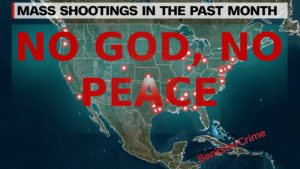
No God, No Peace: The Role of Faith in Finding True Peace
Around the world and throughout history, people have searched for peace—in their communities, their families, and their own hearts. Yet many have found that lasting, deep-rooted peace is elusive when spiritual meaning is absent. The phrase “No God, No Peace” captures the belief that without God, genuine inner calm and societal harmony are difficult, if not impossible, to achieve.
The Search for Peace
Modern society offers many substitutes for peace: financial success, relationships, entertainment, and even self-help philosophies. While these can provide temporary happiness, they rarely satisfy the deepest need for comfort and assurance, especially in difficult times.
The Biblical Perspective
According to the Bible, true peace comes from a relationship with God:
- Isaiah 26:3 says, “You will keep in perfect peace those whose minds are steadfast, because they trust in you.”
- John 14:27 quotes Jesus: “Peace I leave with you; my peace I give you. I do not give to you as the world gives. Do not let your hearts be troubled and do not be afraid.”
Believers testify that faith provides hope, purpose, and assurance that stand firm even amid life’s uncertainties.
Societal Impact
History is full of examples where turning away from faith led to unrest, division, and a breakdown of values. When societies drift from the moral foundations rooted in belief in God, violence, anxiety, and confusion often follow.
Conversely, faith communities have long been centers of reconciliation, charity, and healing—offering support and hope to individuals and whole societies in times of crisis.
How Faith Brings Peace
- Connection to a higher purpose: Knowing one’s life is grounded in something eternal provides courage and calm.
- Forgiveness and reconciliation: Faith encourages people to forgive, heal, and pursue peace with others.
- Hope in hard times: Believers rely on God’s promises, which bring comfort despite external circumstances.
Conclusion
The message of “No God, No Peace” is a call to remember that spiritual life is essential for both inner tranquility and social harmony. By seeking God, many find the lasting peace that the world cannot offer—peace that endures, even when everything else seems uncertain.
“For he himself is our peace.” — Ephesians 2:14