BY SRH
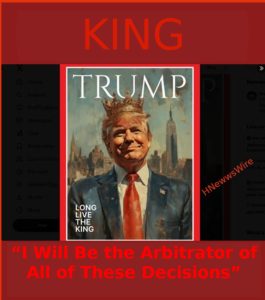
Donald Trump has called himself a king. In a post to Truth Social on Wednesday, Feb. 19, the president, 78, praised his own efforts in attempting to revoke revoking New York City’s recently reinstated congestion pricing system. “CONGESTION PRICING IS DEAD. Manhattan and all of New York, is SAVED,” he wrote, adding, “LONG LIVE THE KING.” Shortly afterwards, the official White House Instagram account shared a fake Time magazine cover, depicting Trump wearing a crown. In place of the magazine’s title was Trump’s name in big letters — and again, at the left corner, read the words, “Long live the king.”
In a land where debates grew heated and people longed for clear direction, King Trump rose to address the crowd. With confidence, he declared, “I will be the arbitrator of all of these decisions.” The courts, councils, and advisers paused, waiting for his next words.
The people watched as King Trump listened to disputes—over borders, trade, and laws. His judgments were swift and final, sometimes cheered by his loyal followers and questioned by his critics. As time passed, the king’s central role united some and divided others, leaving the nation to ponder: Should one voice decide all, or is wisdom found when many are heard?
Side Bar:
President Trump Unveils Whistleblower Reward Program
From the Oval Office, President Trump announced that the federal government will pay whistleblowers who report fraud against taxpayers, stating, “I will be the arbitrator of all of these decisions.” Vice President JD Vance, who oversees the administration’s fraud task force, joined him for the announcement.
Trump’s new initiative promises informants a 1% commission on reported fraud, no matter the amount—even up to 100billion—withpaymentsmade“immediately.”Theprogram’swebsite,however,specifiesthatsuccessfultipscanreceiveupto100 billion—with payments made “immediately.” The program’s website, however, specifies that successful tips can receive up to 30,000, depending on the outcome. When asked about this discrepancy, Trump insisted there are no limits and that whistleblower reports do not require resulting charges.
The Department of Justice is launching the $25 million program, though questions remain about how such large payouts would be managed. Tips will be encrypted and sent to the Treasury Department, with Trump himself resolving disputes when multiple people claim the same tip.
The first payout went to Nick Shirley, a YouTuber who received 10,000foravideospotlightingallegedfraudinMinnesotachild−carecenters,thoughstateofficialslaterfoundnoevidencetosupporthisclaims.Despitethis,federalprosecutorsinMinnesotahavechargedover100peopleinunrelatedfraudcasessince2022,withthe10,000 for a video spotlighting alleged fraud in Minnesota child-care centers, though state officials later found no evidence to support his claims. Despite this, federal prosecutors in Minnesota have charged over 100 people in unrelated fraud cases since 2022, with the 300 million Feeding Our Future scheme as a focal point.
While existing programs like the False Claims Act have awarded whistleblowers a percentage of recovered funds—often higher than Trump’s 1% offer—the administration argues most current fraud falls outside their scope. The Treasury also runs a separate program offering 10% to 30% for tips on certain types of financial wrongdoing.
Some critics question the motives behind Trump’s plan, advising that more focus should be placed on strengthening protections for whistleblowers. Meanwhile, it is estimated that the U.S. loses up to $500 billion each year to fraud.